
Contributed by Rachael, Ancesister @ Ancestreats.
Bialy
Pronounced “bee-AL-eeh,” in Yiddish: ביאלי, is a Yiddish word short for bialystoker kuchen (ביאליסטאקער קוכען), which originates from the city of Białystok in Poland. These are yeasted, individually-portioned rolls that are a traditional dish in Polish Ashkenazi Jewish cuisine. At first glance, you might think a bialy is just another bagel. But you would be very wrong.
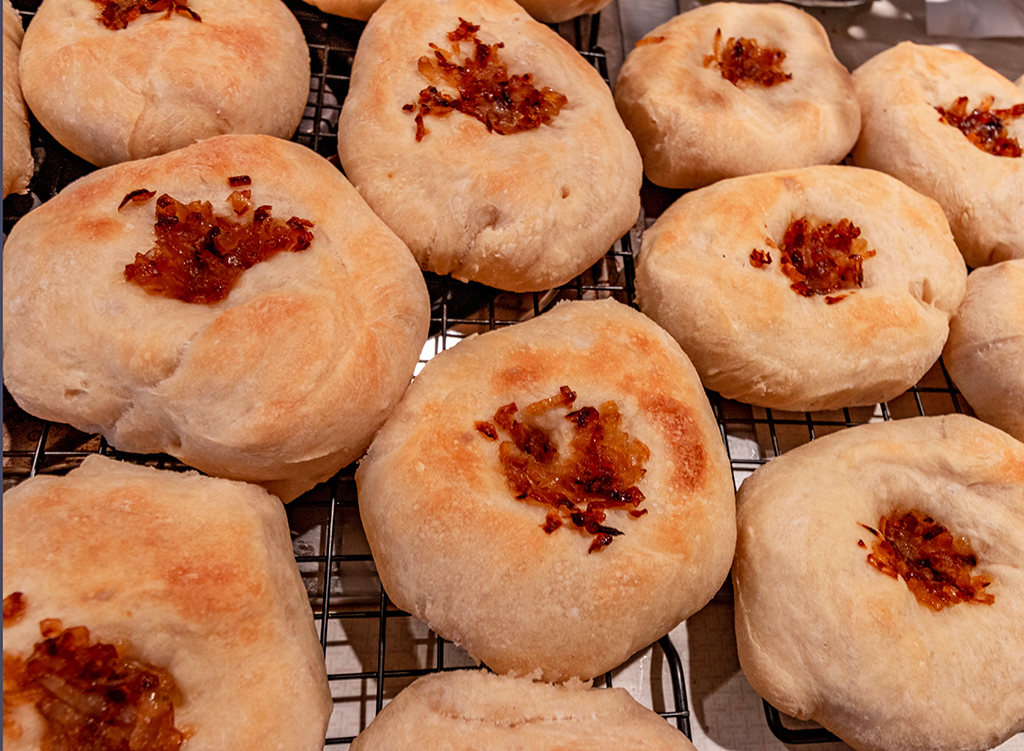
Bialy is an eggless flatbread roll made from gluten flour and baked without pre-boiling. Consider it a cousin to the bagel, which contains malt, is boiled before baking, and is formed with a hole in its center. Bialys keep their middles. In fact, their belly-buttons are dolloped with savory morsels like chopped caramelized onions, garlic, and poppy seeds.

Bialys satisfy a primal craving for savory carbs. You can eat them plainly, fresh off the cooling rack. You can top them with lox and cream cheese. You can toast them with butter. Bialys can be enjoyed for breakfast or lunch sandwiches (although I’ve rarely sliced them for a sandwich: it can be done). They are a small pleasurable creature comfort.
Unlike the hole you expect on a bagel, a bialy has a central indentation that gets filled with savory morsels of caramelized onions and poppyseeds [if you have them]. The dough is yeasted but does not use eggs. If you use vegetable oil instead of butter, a bialy is perfectly vegan and parve. I know plenty of people who like that because of kosher dietary restrictions and food allergies.
The preparation of bialy dough is easy and eating them fresh in your kitchen is quite wonderful. If you have the supplies, double the recipe (you needn’t double the yeast because that only makes the fermentation go faster), and after cooling them off, put half the batch in the freezer in a sealed freezer bag, where they keep well. After 2 days on the counter (if your eaters haven’t swallowed them already), they begin to go stale. Toasting them will crisp up their outer crust and warm up the incredible flavorful bits in the center. If you don’t have a bakery to support, and you are hankering for carbs, this is the recipe for you.
I grew up eating bialys. Contrary to what I have read on other food blogs, bialys have indeed been available outside NYC, wherever Polish Jews have been baking traditional bread. My family bought them from kosher bakeries and delis North of Boston. One particular venue on Route 1 North, near Malden where my parents grew up, was where dad scored our bialys. I remember sitting in the backseat of the family car, reading a book in my own world while dad disappeared into the shop. When he returned to the car, the aroma of the onion bialys would fill the cabin. He would let me eat one right then. Mmm. That’s a pleasant memory.
If you live away from a center of Ashkenazi Jewish culture, you may be hard-pressed to find a fresh bialy. Yes, good bagel shops ought to make them. They should offer bialys as special orders if they don’t prepare them on the regular. I’m in Albuquerque. Before the pandemic, I drove outside my city limits to Rio Rancho where I found a decent bagel deli that can make bialys. But in these Stay-At-Home times, there is a revival in home baking going on. Frankly, you may want to make bialys in your very own kitchen.
When I prepared the batch pictured above, my second oldest child was immediately hooked. His favorite method of eating bialys was to nibble around the center and save the onions for a final mouthwatering bite. I am partial to eating around the center, taking small bites of the onions with each mouthful. Really, what a simple pleasure no matter how you enjoy them.
INGREDIENTS
BIALY ROLLS
2 cups/250 ml–warm water (up to 115F/46C)
2 1/4 teaspoons/11 ml–active dry yeast*
2 tsp / 4.9 ml–granulated sugar
2 1/4 teaspoons/11 ml–salt
1 3/4 cups /219g–bread flour**
3 1/2 cups / 438 g–AP flour
*These could be made using sourdough starter if you have sourdough discard ready to go. It would require one extra day, in advance of baking, for the leavening stage. I have been using my discard for baking crumpets and challah. If you prepare with a sourdough starter, share your tips in the comments below!
**Use what you can procure: if you don’t have bread flour, use all AP, and don’t sweat it! Also, if you substitute wheat flour for bread flour or some AP flour, you’ll need to hydrate the dough more (add more water) because whole-grain flour is thirstier by nature and it’s also less elastic. In the comments below, let us know your alternative proportions and how the final product came out!
BIALY TOPPINGS
1 T olive oil
1/3 cup minced onion
1/2 tsp kosher salt
1 1/2 tsp poppy seeds**
2 tsp minced garlic**
**Onions are non-negotiable, but these additional morsels can be omitted if you don’t like their strong flavors, or can’t procure them.
INSTRUCTIONS
PAN PREP: Set up two half-sheet baking pans: line them with parchment paper.
TOPPING PREP: Saute the minced onions and salt with the oil (and whatever other toppings you decide to use) in a skillet. Carmelize them slowly. Use Medium heat until a rich dark color sets in; be careful not to burn or scorch them. Set the mixture aside to cool. When you bake the rolls, the fillings will continue to cook and the onions will deepen in color and flavor.
DOUGH PREP: In a large bowl, combine 1/2 of the water, all the yeast, and the sugar. Stir to combine. Let stand for 10 minutes or until the mixture is foamy. Depending on the kitchen warmth this can go faster or take longer. Just keep your eyes on it. The reason you want warm–not hot–water is so you don’t accidentally kill off the precious yeast.
Add the remaining water, salt, and flour. Knead the mixture by hand (old school) or use a stand mixer with a dough hook until the dough becomes smooth. It can take anywhere from 8-10 minutes. It’s a soft dough. Depending on the humidity of your kitchen and the flours being used, you may need to add warm water if the dough is too shaggy and dry. If it’s too moist, add more flour. Whichever is your issue, just add one tablespoon at a time to reach a soft consistency. Form your ball and place it in a lightly oiled bowl, turning all sides of the dough so it’s glistening. You don’t want a crust to form on the dough over while it’s resting: cover the bowl with plastic wrap, and then cover that layer with a tea towel.
Rise one: let the dough rise until it is tripled in bulk. Depending on the temperature of your kitchen, this can take 1-3 hours.
Rise two: punch down the dough inside its bowl, turn it over and recover with plastic and towel. It will double in bulk after 45 minutes-1 hour.
[HELPFUL KITCHEN HACK FOR THOSE WITH COLD, OR DRY KITCHENS: fill a saucepan midway with water and bring it to a boil. Move your bottom oven rack shelf to the lowest position and place the saucepan of water, uncovered, on that lowest shelf. The second oven rack shelf should go above in the oven’s center. Place the bowl of rising dough on the centered rack. There should be room for the bowl and risen dough. Close the oven door. Steam from the hot water will bring up the oven’s internal temperature, and that will promote a great rise. I live at high-altitude in a dry high-desert. I use this method almost every time I bake bread. Alternatively, you can let your dough rise in the fridge overnight. I don’t do this. With a family of 5, it’s near impossible to give up fridge shelf real-estate. You do you.]
On a floured counter or large cutting board, empty out the dough and punch it down. Roll it into a log and then use a bench scraper or sharp knife to divide the dough into 8 same-sized portions; start in the middle and make subsequent cuts in the middle of each cut piece. Shape each portion into a circle and lay each, evenly spaced, on the baking tray. They should be approximately 3-4 inches in diameter. Cover them with plastic wrap and put them back into the warm humid oven for another 30 minutes so they rise in bulk by half.
Remove them from the oven, and use two fingers to make an indentation–a belly button–from the center outward leaving a rim of 1 inch. Place a dollop of 1 tsp of the topping in each navel. Cover the rolls again, leaving the sheets on the kitchen counter for the final proofing. When the dough puffs up, the bialy navels will get surrounded without becoming completely covered over.
Meanwhile, remove the saucepan of water from the oven. Move the center rack to the top-most shelf spot. Preheat the oven to 425F/218C.
Bake each sheet pan for 6-7 minutes then reverse their shelf and rack positions for another 6 minutes. The outside of each bialy should be lightly browned. Don’t overbake them because they will become too dry. Remove from the oven, put on the wire cooling rack until fully cooled. Place the bialys inside a sealed container or plastic bag. As I mentioned before, double the batch and put half in the freezer, inside a tightly sealed bag. These are enjoyed lightly toasted. They can be stored in the freezer and removed onesie-twosie. When they’re gone, you will want to make another batch!

 ancestreats.com